You see more with a camera than without one.
Your lens is sharper than your eye. Your lights give the colour back. You spend the dive noticing things you would have swum straight past, and you bring them home.
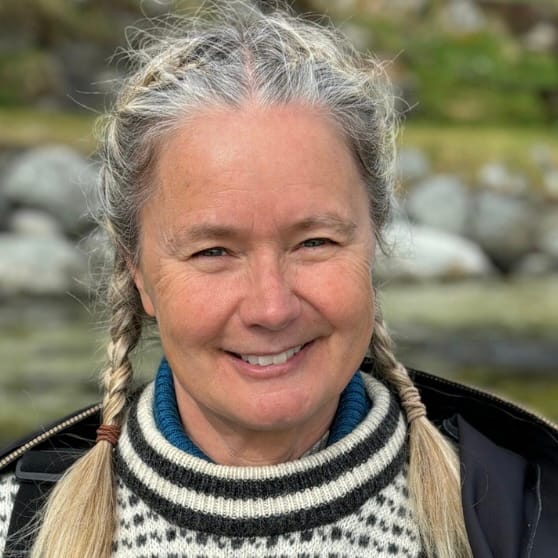
Hello, I'm Tove.
I have had three careers. Between them they explain everything I teach.
I learned the underwater camera trade from Ron Taylor, who filmed the original Jaws and built my first housing. Since then, around thirty episodes for Animal Planet and Discovery, Undersea Specialist and Video Chronicler for National Geographic Lindblad Expeditions across six continents, and a year on Jean-Michel Cousteau's team for Voyage to Kure.
Before any of that I was a PADI Instructor and a working Divemaster, responsible for people in every condition I could find. And for years I was an accredited stunt performer in Australia, where I prepared so thoroughly that if something went wrong I was already looking for the way out instead of freezing.
Based in Haugesund, on the west coast of Norway. I teach in Norwegian and in English.

What the camera actually does down there
In Norway you are diving in low light conditions in comparison to the tropics for most of the year, and colour leaves us faster. Only a few metres down the red has already gone.
With your own eyes it can look bleak. Green, grey, not a great deal happening.
Then you put a lens and a pair of lights in front of you. The lens gathers more than your eye does. The lights give the red and the yellow back, one small area at a time, and that area comes alive. Detail you most likely would have swum straight past - is suddenly in front of you.
I film small things I cannot properly see while I am filming them. I come home, put them on a big screen, and there is purple and yellow and a level of detail I had no idea existed in Norwegian water. Thirty odd years of diving, and the camera still shows me things my eyes have never given me.
So the equipment is not only there to bring the dive home. It is there to let you see the dive properly while you are underwater.
The tropics works the other way round. Clear, shallow, full of light, and your eyes do very well on their own. The camera is still seeing more than you are, it is just less obvious, and the moment you go below ten or fifteen metres the colour starts leaving there too. Same physics everywhere.
Cold water simply makes it impossible to ignore.
It was never about who had the better camera.
I spent years standing next to cameramen with better equipment than mine, watching them miss shot after shot and then explain it to directors who did not know better. I would be right there with nothing in my hands, already knowing where the shot was.
The camera matters. It has to be ready, and you have to know it well enough to stop thinking about it. So does your diving: your weights, your trim, a dive you are comfortable on rather than one you are managing. Everything you settle before the dive is attention you get back during it. And attention is the whole thing, because it is the only part the water responds to.
That is why a fish turns toward your lens instead of swimming away. You saw it coming, you put yourself where it was going, and you were calm enough to let it decide. No camera does that part for you.
The camera is what lets you see the ocean properly. Where you are when the moment arrives is you. Those are two different jobs, and only one of them is for sale in a shop.
The industry sells the gear, so the industry teaches the gear. I sell no cameras and no housings, so my advice has nothing to protect but your shot. What I teach works on a GoPro, a phone, or a cinema camera, because the camera is not the variable.
The shot can be decided before the animal arrives. It is not talent. It is a skill, and it is teachable.
What changes
01 You see the ocean as it actually is.
Your lens reaches further than your eye and your lights put the colour back, so you spend the dive seeing things you would otherwise have swum past.
02 You find out it was always you.
The first time a shot works because of where you put yourself, the whole gear question goes quiet.
03 You stop guessing.
You go in knowing what you are doing and why, instead of hoping the dive gives you something.
04 You come home with something worth showing.
A clip you are proud to put in front of someone who will never dive, that makes them care about a place they will never go.
05 The animals come closer.
You read what is in front of you and put yourself where it is going, so it approaches you rather than leaving.
06 You keep getting better after I stop teaching you.
Because you understand why a shot worked, you can repeat it. And you leave with people who dive the way you do.
Not a cinematographer in a weekend. I will not pretend otherwise. A diver who knows what to do and when, enjoys the dive more than before the camera arrived, and owns the result.
WHAT THAT TAKES, CONCRETELY
Setting your camera for the dive you are about to do, and operating it without looking
Weights and trim sorted so nothing about your kit takes your attention
Holding position and changing position without losing balance
Moving so you do not disturb the subject, and approaching so it lets you close
Reading a situation and being ahead of it rather than reacting to it
Placing a light so it lights the subject and not the particles in the water
Using the light that is already there, on purpose
Recognising the shots that will cut together while you are still on the dive
Getting your footage organised instead of drowning in it
Building a simple story out of an ordinary dive
What I offer.
In-water workshops
Six divers, one weekend, me in the water next to you. We settle your camera and your dive gear first, because nothing else is available until those stop taking your attention. You leave with footage you are proud of, a method you can repeat without me. Run in Norway, and at dive destinations abroad.
Online courses
The same method, self-paced, for divers who cannot get to Norway and for anyone who wants the thinking settled before they arrive at a workshop.
In production now.
Speaking and film work
Talks for clubs, federations, schools and events, in Norwegian or English. And underwater camera work, expedition support and video chronicling for productions. Thirty years of it.
From people I have worked with.
Vibeke Solbue
Workshop participant
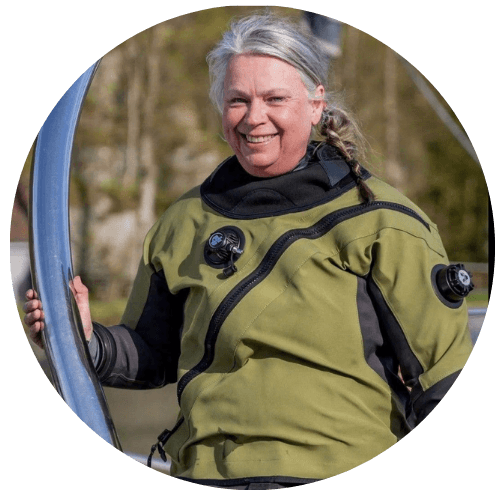
"The course is hands-on. You learn concrete tips for underwater filming and try them out in the water with guidance. Tove is good at showing what she does when she films and builds a story, so you learn a lot from watching it done. I've already published my first film after the course, and dive friends are joining the next one to learn too. I recommend it, without hesitation."
— Vibeke Solbue
Norwegian Scuba Diver
Jean-Michel Cousteau Ocean Futures Society
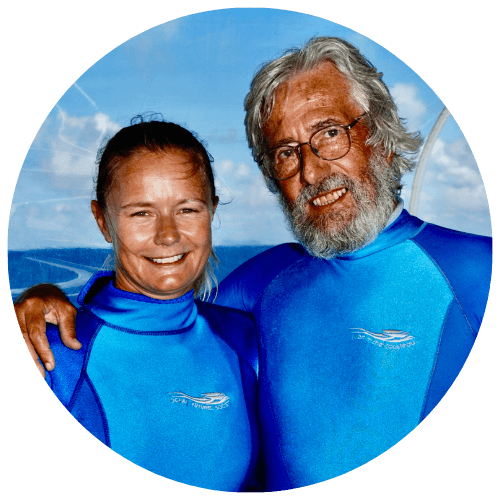
"When I formed a new Cousteau team, Tove Petterson was one of the first to come to mind. Her skills, professionalism and experience in documentary filmmaking, above and below water, are exceptional. On our 35-day expedition to the Northwestern Hawaiian Islands her work was essential to our success, and her presence was an inspiration to the whole team. She has my highest endorsement."
— Jean-Michel Cousteau, President, Ocean Futures Society
Judith Curran
Executive Producer NHNZ

"Tove is without question one of the most highly skilled underwater professionals I have ever worked with. She was a principal underwater camera operator on The Adventures of the Quest, which I produced and directed, and she always gets the shot the director needs, whatever the challenges. A delight to work with on every part of a production."
— Judith Curran, Executive Producer, NHNZ
Workshops opens a few times per year, and the seats go to this list first.
Six places, every time. They fill from here before they go anywhere else. Leave your name and I will write when the next one opens.
Most people will never see any of this.
They will never put a mask on, and the ocean will stay an idea to them. It stops being an idea the moment someone who was actually there brings it into the room. That is what your footage is for, and it is why I teach this instead of something easier.
Throwback/Adventures of the Quest 2000 Animal Planet Dominican Rep
Throwback/Adventures of the Quest 2000 Animal Planet Costa Rica
West coast Norway & Indonesia - GoPro 8 & OMS TG6
West coast Norway - Z Cam E2 F6 - 100mm f2.8